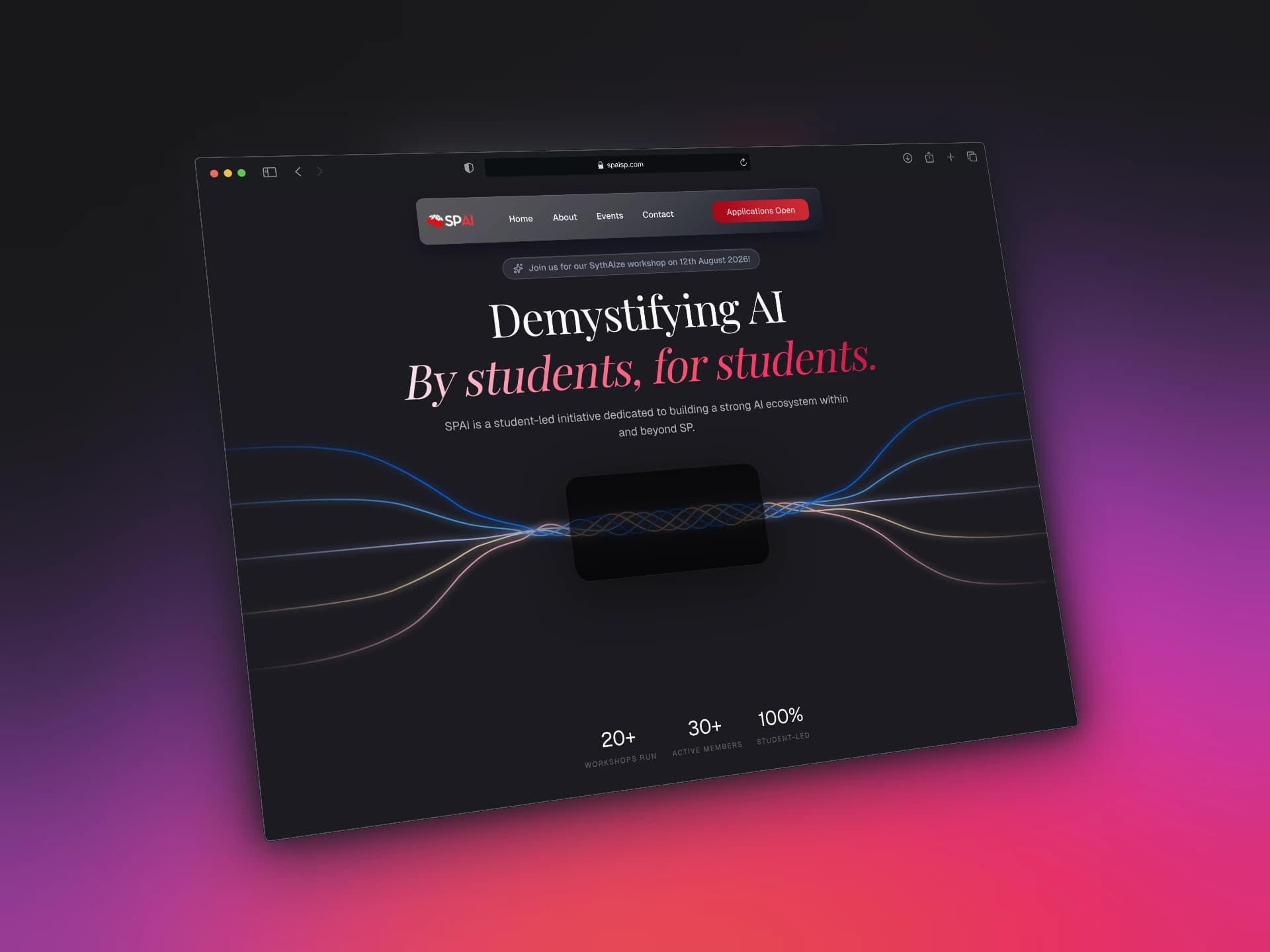
A student chapter with no public home
SPAI, the Singapore Polytechnic Artificial Intelligence student chapter, is a student-run club made up of SP's constituent clubs. The chapter already had a logo, a red-and-white visual identity, and activities to share. What it lacked was a website that students could find and pass on to others.
The project was about visibility. A public site could make SPAI feel more established, give prospective members somewhere to learn about the chapter, and give the club one link to use for recruitment when new students arrived.
The site gave SPAI's existing community a public front door.
The audience was broader than the subject
The hardest design decision was working out who the site needed to speak to. SPAI is about artificial intelligence, but its audience included students outside computing. Someone from Chemical and Life Sciences, or any other course at SP, should still be able to understand that the club exists and decide whether it is worth joining.
The site needed to feel student-led and credible without sounding like a technical organisation explaining concepts to specialists. The existing red-and-white brand gave the page a clear starting point. The rest of the system had to carry that identity clearly for people encountering SPAI for the first time.
The subject was AI, but the audience was every student who might be curious about it.
Clarity won over the more glamorous idea
I built the site independently in Next.js and used AI to prototype directly in the page instead of working from a separate design tool. The content was simple on purpose: an introduction to SPAI, an explanation of what the chapter does, recent events, a contact area, and a clear application path when recruitment is open.
I tried heavier, more glamorous ideas, including a possible 3D section, but they did not fit the actual constraints. Most students would likely visit on mobile. A visual that made development machines run hot was unlikely to be a responsible production choice. The final design is simpler, fits the brand better, and is more likely to work for the people the site is for.
An idea can be good and still be wrong for SPAI's site.
The site had to survive after I stopped editing it
A static description would be outdated as soon as the next workshop or meetup was planned. I proposed a content management system so non-technical community administrators could update the events section themselves. Then I connected Sanity to the site and set up the Studio.
Sanity had the steepest learning curve in the project. It was my first time using it, and I initially struggled to navigate the interface and map page elements to editable fields. Once that boundary was in place, the CMS became part of SPAI's regular workflow. The community administrator updates upcoming events when they are ready to advertise them.
A small site made the chapter easier to find
The site launched on 10 April 2026 and gave SPAI a public site to share when recruiting new students and subcommittee members. It also created a public search presence. From launch through the latest 12-month Search Console view, the site recorded 3.78k impressions, 43 clicks, a 1.1% click-through rate, and an average position of 5.9.
Those numbers show that SPAI became easier to find. They do not show that the site caused applications or increased attendance. The more immediate result was a credible public layer that the chapter could share during recruitment and that the people running the club could maintain.
The site needed to be visible, understandable, and usable after launch.