Software breaks. Ideas don't.
Remember started with archived-project pages and a thought: software can be abandoned even when the idea is still useful. Developers may run out of time, funding, or confidence. None of those reasons necessarily says anything about the idea itself.
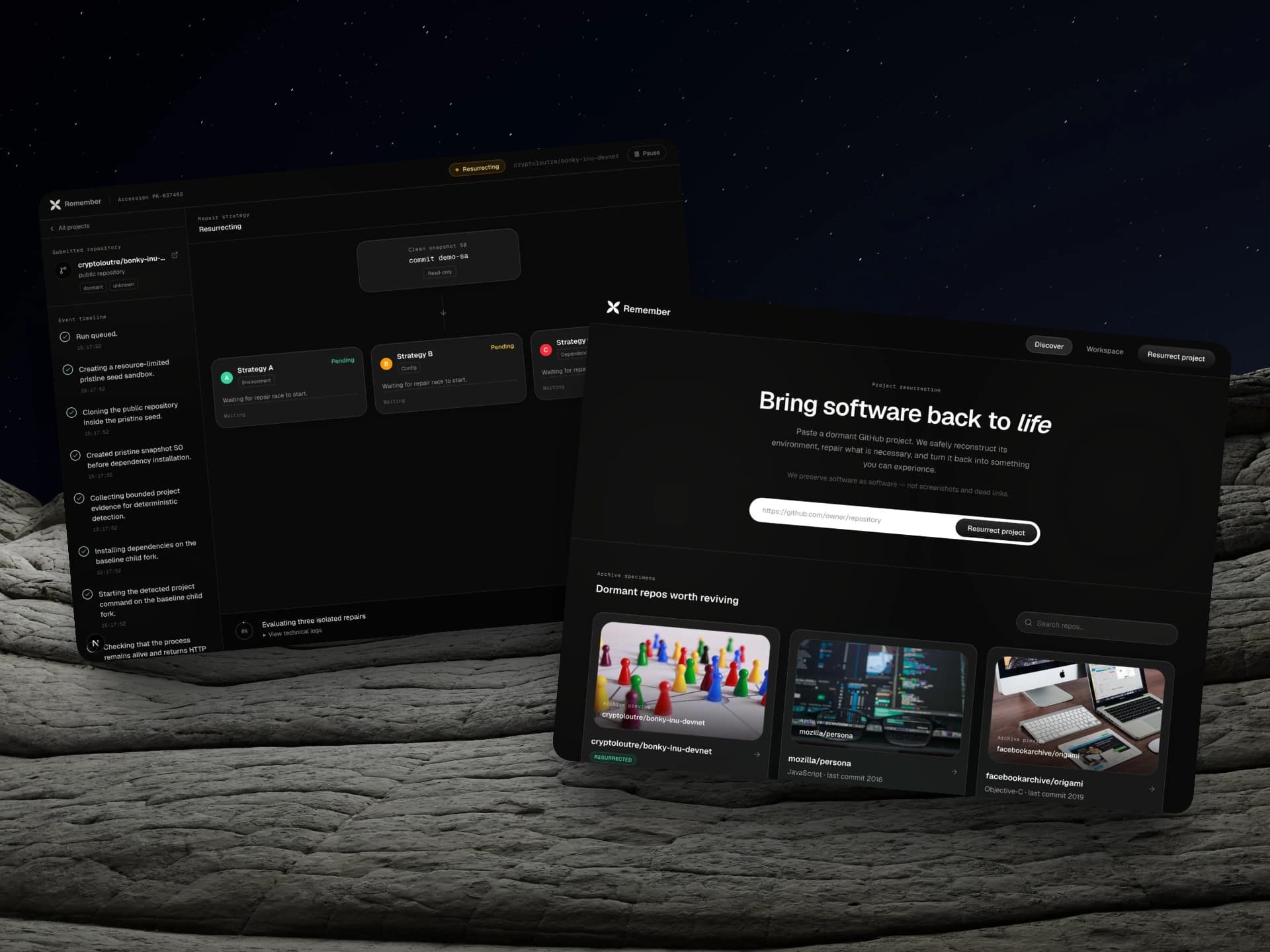
I wanted to give someone else an easier way into those repositories. A new builder should be able to see what a project was trying to do before having to understand the entire codebase, so Remember turned a public GitHub link into a preview they could inspect.
A repository did not have to be perfect. The first question was whether its original idea was still worth seeing.
One paste. Simple.
The flow stayed simple. Paste a public GitHub repository URL, and Remember would create a sandbox around it. Instead of returning another status message, it aimed to produce a quick, shareable preview of what the project was trying to become.
That preview needed honest boundaries. The experiment stayed separate from the original repository, and starting one process did not count as a successful revival. The sandbox and the evidence from the run were part of the result.
One sprint, multiple agent configurations
I built Remember during a five-hour hackathon sprint. There was no time to pretend it was a complete repair platform, so I focused on the interface and workflow. I built the UI, connected the concept to Daytona, and tested ways for multiple agents to work inside an isolated environment.
The sprint also became a test of how I build. I used Claude Code, Cursor, and Codex in different configurations, including parallel sessions and sub-agent workflows. I was testing how to divide a fast product build between exploration, implementation, and review.
Isolation made the idea plausible
Daytona gave the project its safety boundary. Unknown repository commands could run in a sandbox instead of on the user's machine, which made the idea more credible.
Beyond that, I pictured different agents handling inspection, validation, and repair. The prototype explored those workflows, but it did not prove they could work as a reliable general-purpose backend. In the demo, the sandbox contained the risk and gave the judges a clear view of the system's progress.
Using Flappy Bird as a baseline
We used a Flappy Bird repository for the demo. Remember produced a playable preview that kept the core experience, although some presentation details changed and we used a fallback character asset.
The preview did not permanently rewrite the source repository. It showed how someone might recover and explore a dormant project. A five-hour prototype could not claim to have safely restored every implementation detail.
What I learnt
Remember remained a hackathon prototype. It did not prove a reliable success rate, build a complete backend, or establish a safe way to automate arbitrary repository changes at scale.
It did change how I work. I came away with a better understanding of how Claude Code, Cursor, and Codex fit together, and how much an idea depends on clear framing. Even an ambitious technical system needs a simple story: what goes in, what happens inside the boundary, and what comes back out.